MZ

To start navigating Metamorphic Zone, please rotate your device 90 degrees to navigate it horizontally.

×

Sensor

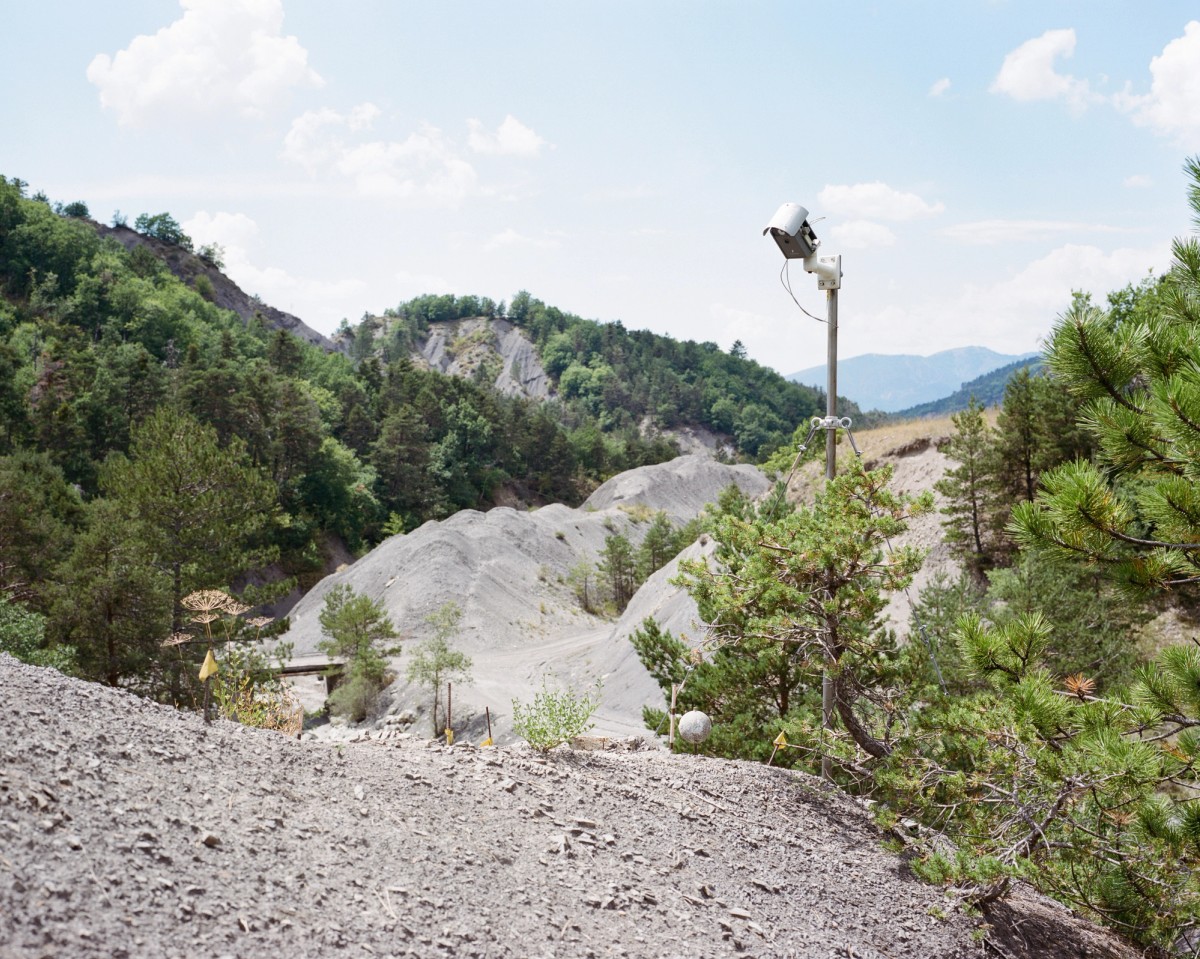
Scientific experiment in Draix, France (for Sensing Earth), Valentin Bansac, 2022.

For an investigation named Sensing Earth, I followed the careful day-to-day practice of geographer Sébastien Klotz, who operates a Critical Zone Observatory in the French Alps. Located at a mountain watershed, the facility accumulates data on the erosion of soils within this very specific ecological situation. For French geochemist Jérôme Gaillardet, in La Terre Habitable (2023), the Critical Zone “refers to the superficial and very thin layer at the surface of our planet, which is located at the interface between the atmosphere and the earth’s crust”.

To understand the subtle relationship between climate and erosion through the geological, natural, and anthropogenic processes – characteristic of the Anthropocene – that occur within this particular location, a set of local, meticulous, and repetitive manipulations is executed. The on-site practice of Klotz relies on the dissemination of various low-tech sensors that, together with the careful annotation and collection of daily data, facilitate a detailed understanding of what ecology means in practice. This practice of reading rain gauges, measuring quantities of sediments within samples, and collecting data over a large time span is what renders comprehensible the subtle mechanisms that engender habitability in this specific territory.

Data gathering, environmental monitoring and simulations are central to Earth Science development, relying on an extensive sensing apparatus that includes remote sensing satellites, radar systems, LiDAR scanners, atmospheric monitoring sensors, optical instruments, and more. Scientific observation goes beyond being a mere direct reflection of objective matters through sensing techniques. It emerges from a complex interplay of various actors and processes – observers, instruments, methodologies, conversions, observed phenomena, and interpretations. For instance, remote sensing collects and records electromagnetic radiation reflected from the Earth’s surface. These captured signals are transmitted electronically to ground stations, where they are received and processed. During this phase, raw data is transformed into interpretable formats, ultimately resulting in images that can be interpreted both visually and digitally for analysis and application.

Within the process of transforming signals, raw data, and images, the sensing apparatus transcends its initial role as a mere observational tool. Instead, it becomes an active agent, entangled within a network of relations that simultaneously shapes sensing practices and transforms fields of knowledge production. Matter and environments are no longer passive backdrops but participants that co-produce the outcomes of observation.

This transformation of environmental sensing calls a shift of scientific paradigms from matters of fact to matters of concern by engaging with a multiplicity of entangled relations shaped by diverse actors and processes. This cognitive shift does not seek to undermine the authority of scientific observation and experimental results, nor does it diminish the pursuit of high-precision instruments. Instead, while maintaining the need to continuously refine scientific instruments, approaches, and institutions, it emphasises patterns of difference and marks complex processes of modulation. Ultimately, this shift urges a commitment to understanding which differences matter, how they matter, and for whom they hold significance.