Scientific classification exists to stabilise what matter refuses to be. Alessio Pinton takes this impasse not as a failure but as a generative method. The conversation, centred on Alessio's publication An Amalgam Paradigm, moves across multiple registers at once: the formation of the Dolomites through the sedimentation of ancient marine organisms, the necessity and limitations of scientific classification, and a publication designed as a form of sedimentation. Each operates by the same logic. Categories are vessels, not verdicts, and the continuity they interrupt keeps reforming.
The framework Alessio develops does not dissolve classification. It integrates it, showing how the approximations that language requires are less a shortcoming than an opening where biological and geological forces, long held apart by the hierarchies built into naming itself, can be read as states of the same ongoing process. An Amalgam Paradigm names this condition and performs it simultaneously.
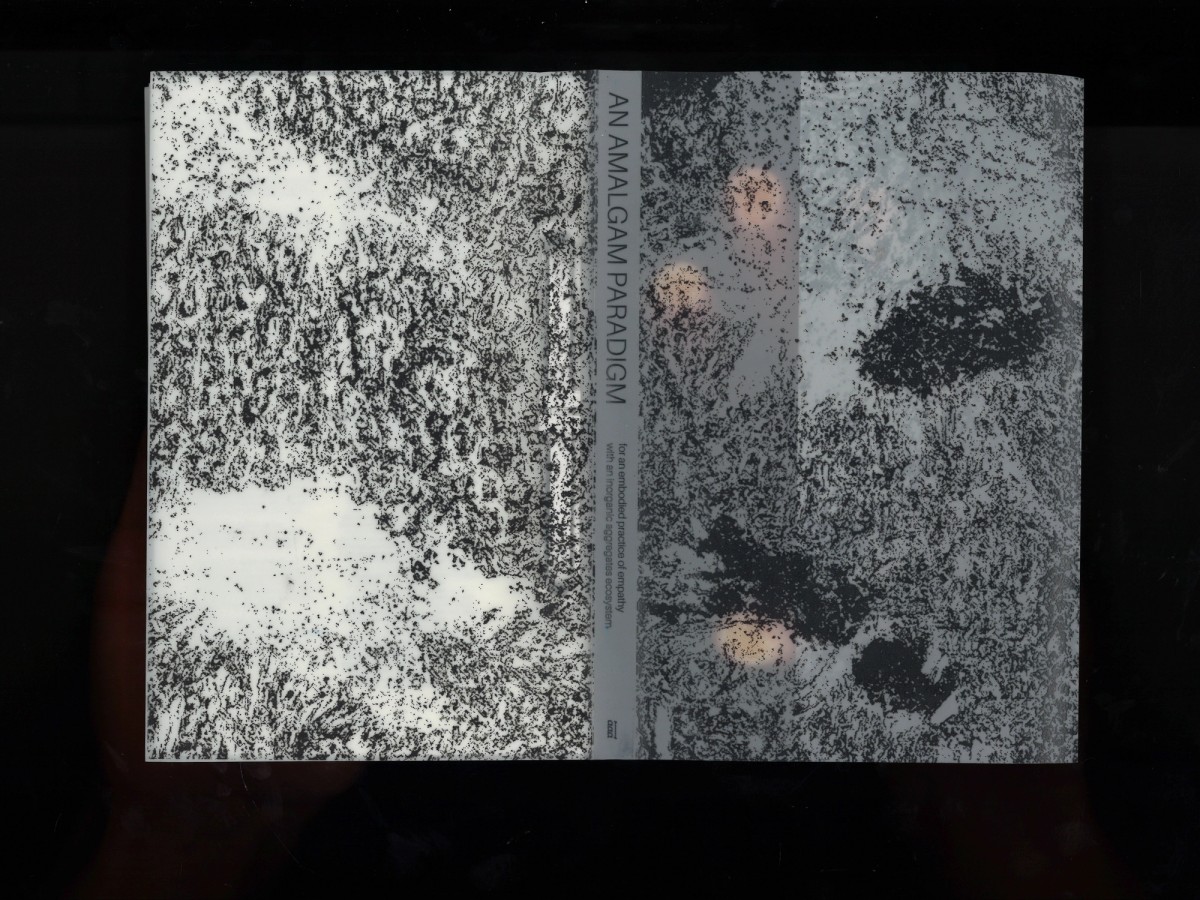
In your publication, you trace the origin of your research to an early encounter with minerals: pyrite fragments on a desk, a wall display case, and small ammonites in a corner. How did that childhood collection evolve into the critical lens of fossilisation that now drives your practice?
Despite the scientific themes, my practice has very personal roots that originate in my childhood. During those years, I was deeply influenced by two family figures close to me: my cousin, an environmental chemist who later moved into geology, and my uncle, a biologist. I was really fascinated by them: I admired their ability to show me the world through the eyes of their knowledge.
My uncle would take me into the forests near Belluno, at the foot of the Dolomites, searching for limeghe, the giant land snails; my cousin to the lagoon in our hometown, Caorle, where she studied pollutants in brackish waters. From time to time, they would bring me rocks and pebbles they would find around, sometimes from a local market, sometimes from their fieldwork. A carpenter who had his workshop next door also once made me a small wall display case to collect them in.
So when I began my thesis research, which later became the first foundation of my artistic practice, I followed that thread. I think what drew me, and still does, towards those minerals was the diversity of their properties: how the same atoms, under different organisational structures, could take on such radically different states, and how some of those states, animated beyond their inorganic behaviour, actively participated in biological processes.
To my child's imagination, each fragment was a creature, and that psychological reversal stayed with me during my whole research, making me perceive geological matter as alive. This led me to realise that it pointed towards something: a more horizontal view of matter, in which passive and active are perceptual rather than factual attributes.
From that point, geological matter felt animated. Mineral species became temporal extracts of the lithogenic cycle: the circular process of erosion, sedimentation, melting and resolidification of rocks. But also, organisms showed themselves as temporal frames of that cycle. From birth to death, our bodies absorb and release minerals, inevitably participating in it. And fossils – I had a couple of them too, small ammonites and belemnites, which I had dedicated a small corner of that display case to – represent the in-between state from biological to geological state. If our life is some kind of erosional path, then fossils are a form of sedimentation.
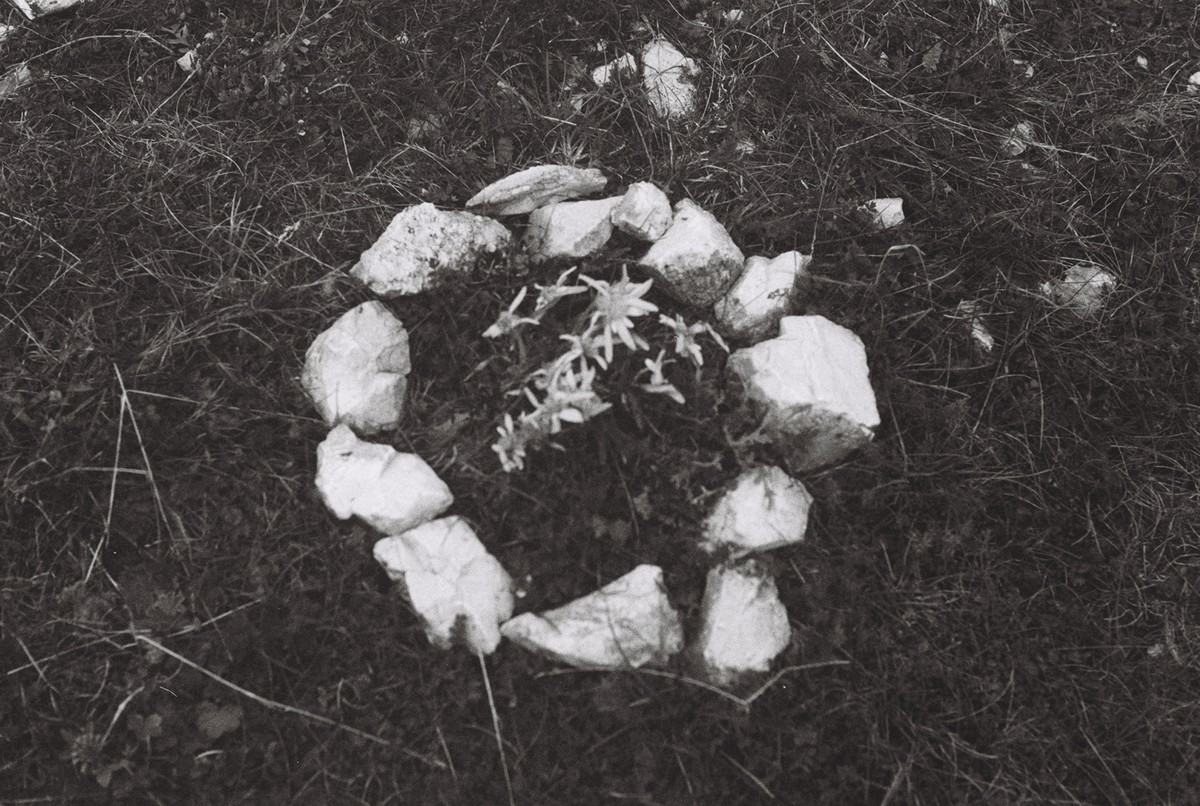
Your project foregrounds the blurred boundary between biology and geology, yet our communication still depends on scientific terminology and fixed categorisation. How does your work navigate this tension between the intrinsic ambiguity of matter and the scientific necessity for precise language?
I think about it in terms of signal types. In digital processing systems, analogue signals can take all possible states between 0 and 1, whereas digital signals are limited to discrete states, meaning they can only be 0 or 1. When we define something as passive or active, we think in binary terms: the nomenclature itself requires a threshold. Assigning a name means creating a 1 and a 0. There is no way around it; it is necessary for communication.
The amalgam paradigm doesn't seek to replace classification but rather to integrate it. Within this framework, subjects appear as momentary states of other subjects: immanent organisational forms to which we assign necessary approximations. Calcium minerals descending a mountain during erosion pass through multiple states and structures: solid rock, dissolved in water, and absorbed by a living organism. In those transitions, there are no wholes, no forms that fully reflect their own nomenclature. There is only material and metamorphic continuity, temporarily assigned to a specific label.
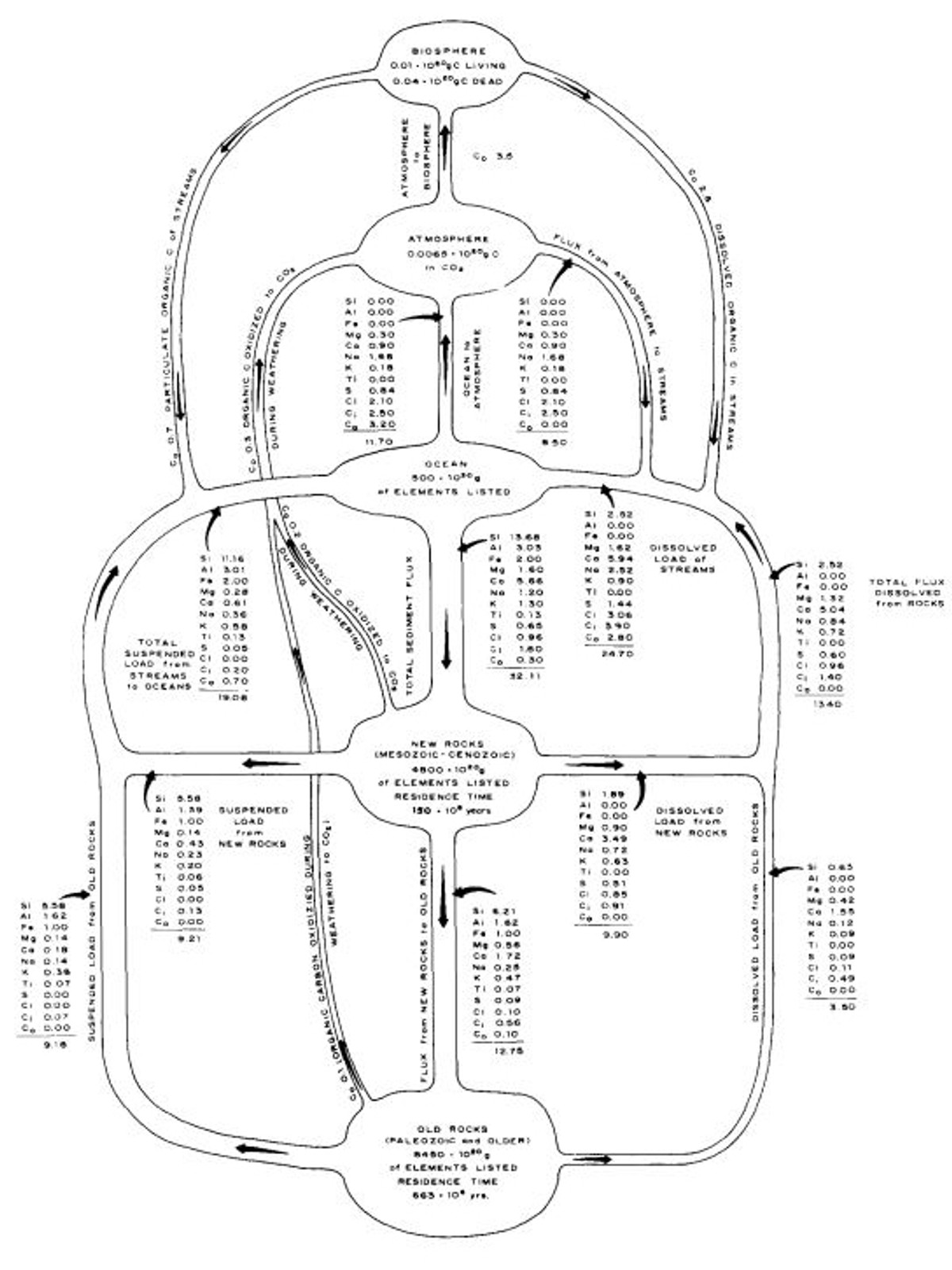
If language inevitably acts as a displacement, dividing and reorganising what is actually continuous, what can your artistic articulation do that scientific language cannot?
Language is a medium closely related to imagination; it shapes reality as perceived, and as such is capable of defining its perception. But the necessity of language to rely on approximation doesn't automatically mean that subjects exist as described.
Through the amalgam paradigm, each entity is redefined as an immanent organisational state: names are revealed as vessels tied to specific patterns, words become containers capable of hosting one form or another, and together they create a context capable of redefining perceived reality. What I wanted to emphasise is the importance of not mistaking words as determinants of reality, rather than just a medium for understanding it.
As an oxymoron, An Amalgam Paradigm seeks to describe, through language, a world without approximation: a continuity that flows through and between organisational patterns. But of course, it is also a reconstruction of reality, which uses words as containers to assemble a context and propose a perspective on it.
You describe the publication as a form of sedimentation, a process not only in how you bring materials together, but also in how the audience moves through the pages. It is striking how language, the materiality of paper, text, and images, collapse and superimpose on each other. There is an amalgam in the publication itself. How did you approach this design as a channel for the idea of amalgam, and what does this overlapping condition make perceptible for the reader?
My biggest source of inspiration was indeed the amalgam itself. Fossilisation, the theme we started this conversation from, was my first source of inspiration, one of the case studies on this gate between organic and inorganic, but the crossing point that most interested me was in the other direction: not the lithification of organic entities, but the capacity of inorganic matter to self-organise into structured, organic forms. I thought of the publication as a cluster made of multiple components: personal experience, philosophical theory, and scientific research, from whose interaction something emergent could arise.
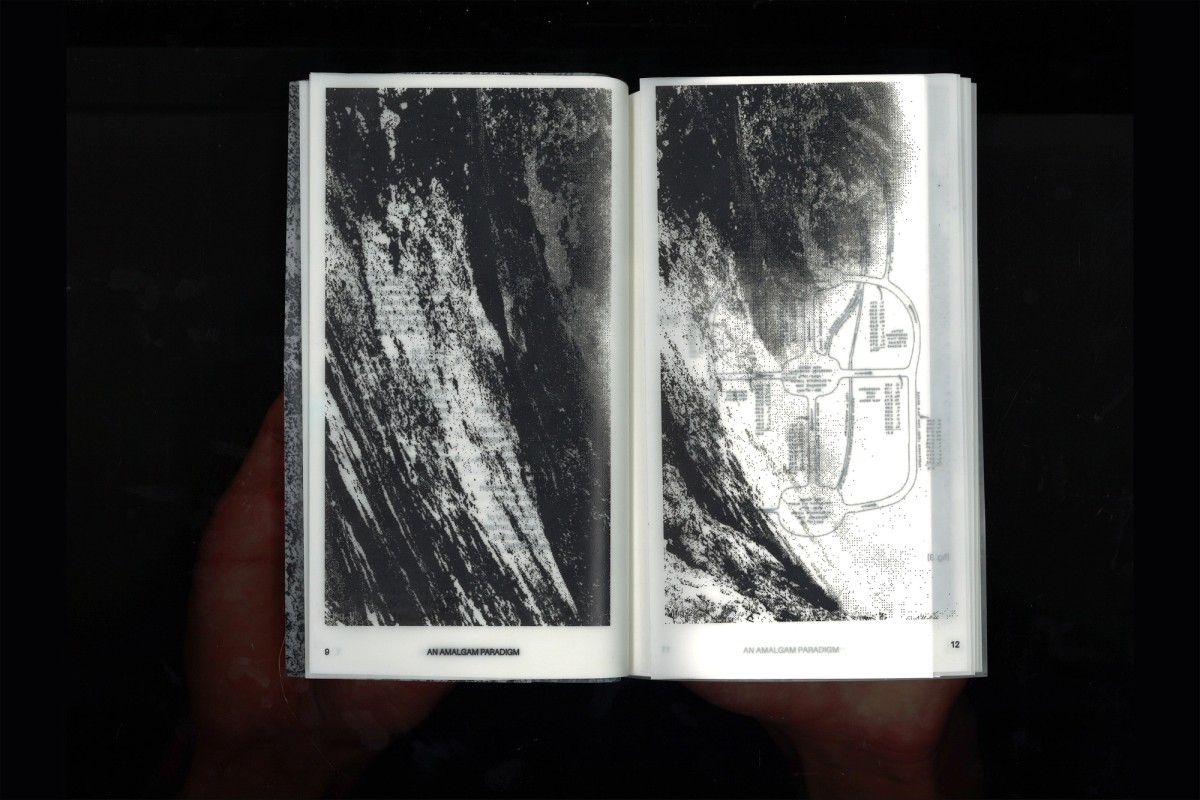
The visual rule was radical, or intended to be: the printed object as a cluster of black ink. Images were dithered to make the individual particles composing them visible. This also served to standardise a heterogeneous collection of analogue and digital photographs, illustrations, and video game screenshots under a single formal logic. A small Python script was written to erode certain textual elements as the publication progresses: footnote references and page numbers deteriorate gradually, formally enacting the erosional themes in the text itself.
Each chapter is wrapped in its own notes and reference images, making it simultaneously an amalgam and a particle within a larger one. And the final pages wrap around to the first, making the publication both content and container at once.
The publication folds back on itself, content becoming container. The Dolomites seem to operate similarly in the book, a place personal to you and a geological argument at once. The ambiguity they carry runs throughout: not only scientifically, but mentally, spiritually, and in language. It suggests a refusal of a clear separation between biological matter and geological matter, and in how we think about what remains unexplained. What does this condition, through the lens of fossilisation and deep time, allow you to see?
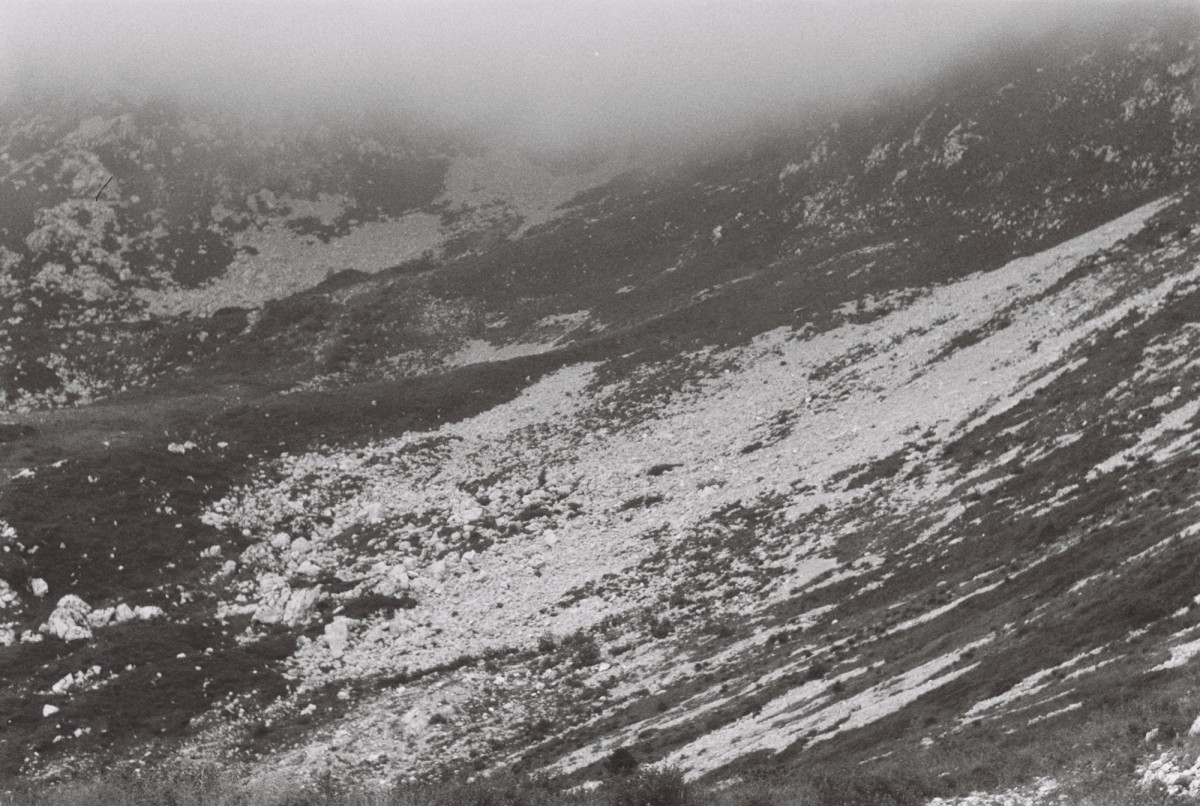
For me, the Dolomites became a perfect example of taxonomic ambiguity, a subject capable of bearing the narrative weight of this amalgamated continuity between one entity and another.
When we think of a mountain range, we think of rock: geological, inorganic, ancient. But the Dolomites are not exclusively geological in origin. Like the rest of the Earth’s crust, the Dolomites are also formed by stratification, but large sections of them are organogenic. The limestone that first formed them is the result of a long accumulation and sedimentation of the shells of microscopic marine organisms, and their origins trace back to the ancient Tethys Sea, a shallow tropical ocean that once covered part of what is now the Italian peninsula.
Volcanic atolls on the seabed provided an environment for ancient marine organisms capable of absorbing dissolved calcium and generating carbonate exoskeletons. Their settlement created formations similar to today's coral reefs; the weight of these caused the seabed to slowly sink, allowing future generations to build upon them. This downward growth produced thick layers of calcium carbonate, later brought to the surface by the tectonic collision of the African and Eurasian plates.
That explains the formation of limestone. But not dolomite, the rock that actually constitutes the Dolomites. Dolomite differs from limestone by adding a magnesium atom to the mineral's crystal structure, and for over two centuries, scientists struggled to explain how this bond formed. Laboratory experiments could only produce dolomite crystals in conditions that bore no resemblance to the mountains' geological history. Following the recent partial discovery of an evaporitic process involved in dolomitisation, the possibility of further biological involvement via bacteria or algae in this process remains open.
What emerged, going deeper into this research, is that these mountains are an ecosystemic fossil: a vast graveyard of former lives that are now cold stone, corpses that have lithified. Learning about the history of the Dolomites helped me to see fossilisation as a geobiological lineage gate, and the Dolomites themselves as a genetically driven mountain range. In the case of the Dolomites, but more generally in any organogenic rock, the development of DNA can literally determine the development of a rock. If the marine microorganisms that formed these carbonate layers had never developed the ability to produce calcium carbonate shells, the Dolomites would not exist as we know them today. For these reasons, I see them as an open-air testament to material continuity, to the amalgamic ambiguity that binds entities together.
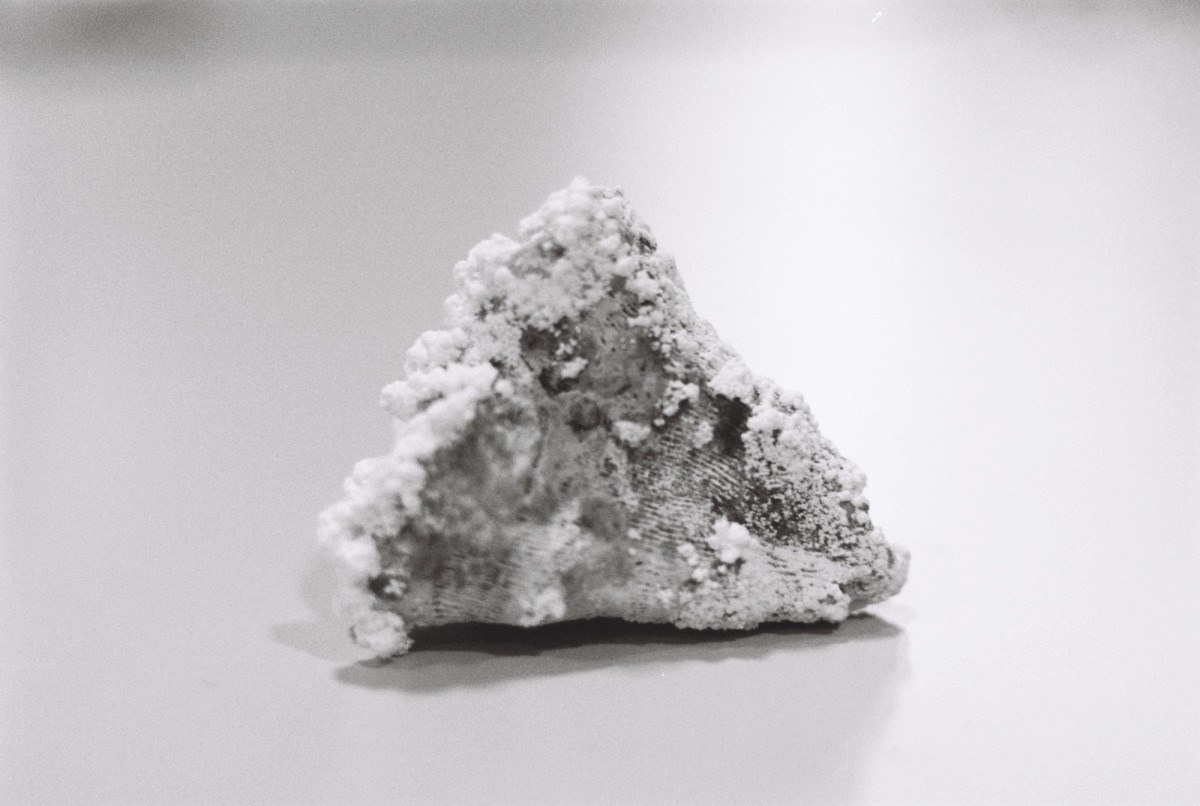
Your link between geology and DNA is intriguing. Building on that, I want to know more about "information": if DNA functions as information for inheritance in biology, what counts as information in your framework, and through what medium does it travel?
Within the amalgam paradigm, what functions as information, in the way DNA functions in biology, are patterns and shapes. And the medium, I would say, is matter itself.
It was weird because, while writing An Amalgam Paradigm, I realised how clearly a distinction kept emerging between form and matter: a distinction in which form was the behaviour and intrinsic property of matter, and in which matter was the substrate and support for form. Through matter, form can be computed. When certain organisational structures repeat themselves, they constitute information: predictable behaviours of matter to which is associated an approximation, a simplification useful for understanding reality. And matter constitutes its computational substrate; it is precisely through matter that form emerges or expresses itself. In that sense, matter is the medium.
The myth of Theseus's ship was a major reference throughout. I had even written a chapter on it that I never published, on how language and the understanding of reality follow the shape rather than the matter of things. The amalgam paradigm, in fact, frames subjects and individuals, but also the approximations useful to language, as Theseus’s ships: phenomena tied to form and organisational structure rather than to the components that constitute them, or let's say that pass through them.
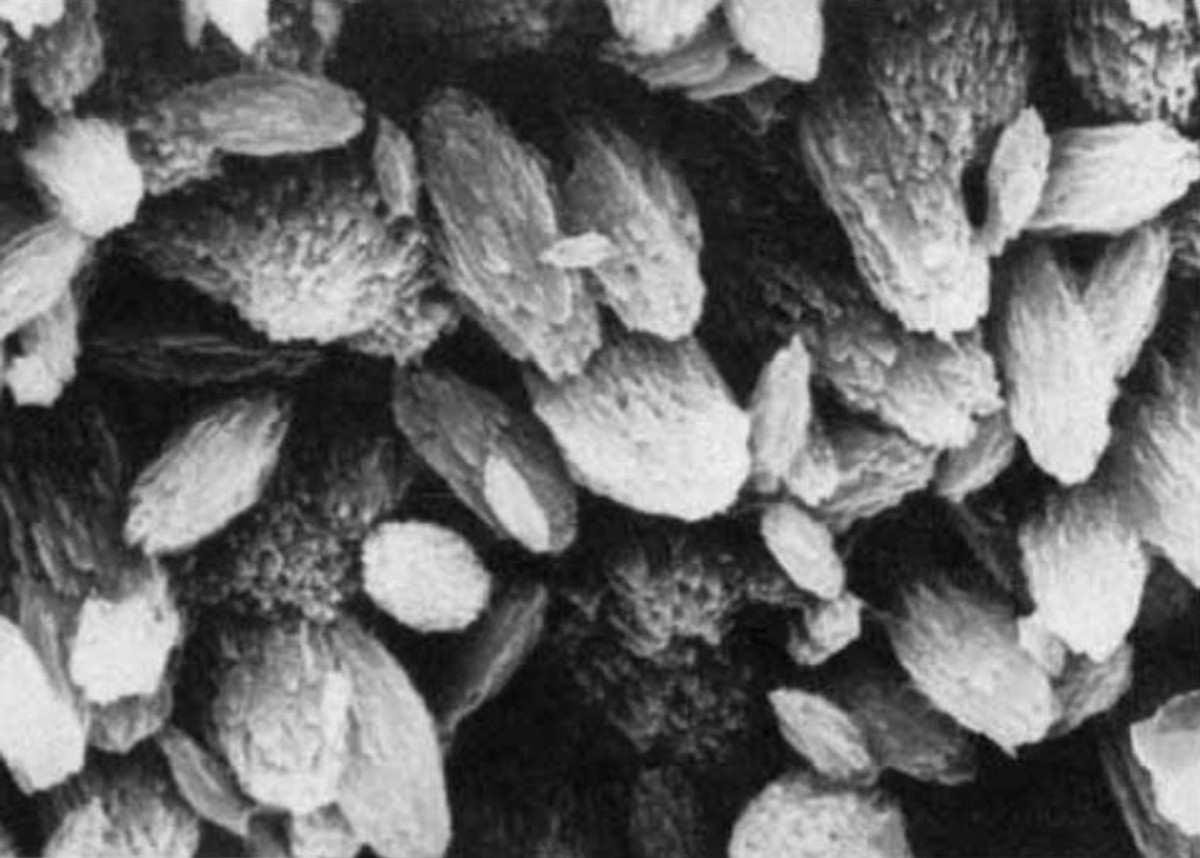
Your framework traces continuity through geological deep time. But artificial materials, as a geological force of the Anthropocene, accumulate and persist outside the cycles you describe. Do they carry a comparable kind of vibrancy and kinship, or do they introduce patterns that sit uneasily within it?
Within this framework, artificial materials are treated like any other. They are new organisational states of matter: molecular structures that were not there before, but ones that will, at some point, return to the same material substrate from which they emerged.
The more pressing question is how these new organisational states operate within a pre-existing context. The amalgam paradigm's position here is not neutral; it is indirect. One of the motivations that drove me to write this piece is an ecological sensibility I've carried all my life. In the introduction, especially, it was important to me to emphasise the recognition of the self in relation to the environment: an expansion of the self beyond one's anatomical boundaries.
Together, the narrative of material continuity, the ambiguity between biological and geological subjects, and the concept of empathy with the inorganic all aim to contribute to a more systemic perception of the self. A perception that cannot allow the subject to be separated from the context it acts within. If the context upon which you rely is harmed, you too are harmed. And being logical about it probably is not enough.